
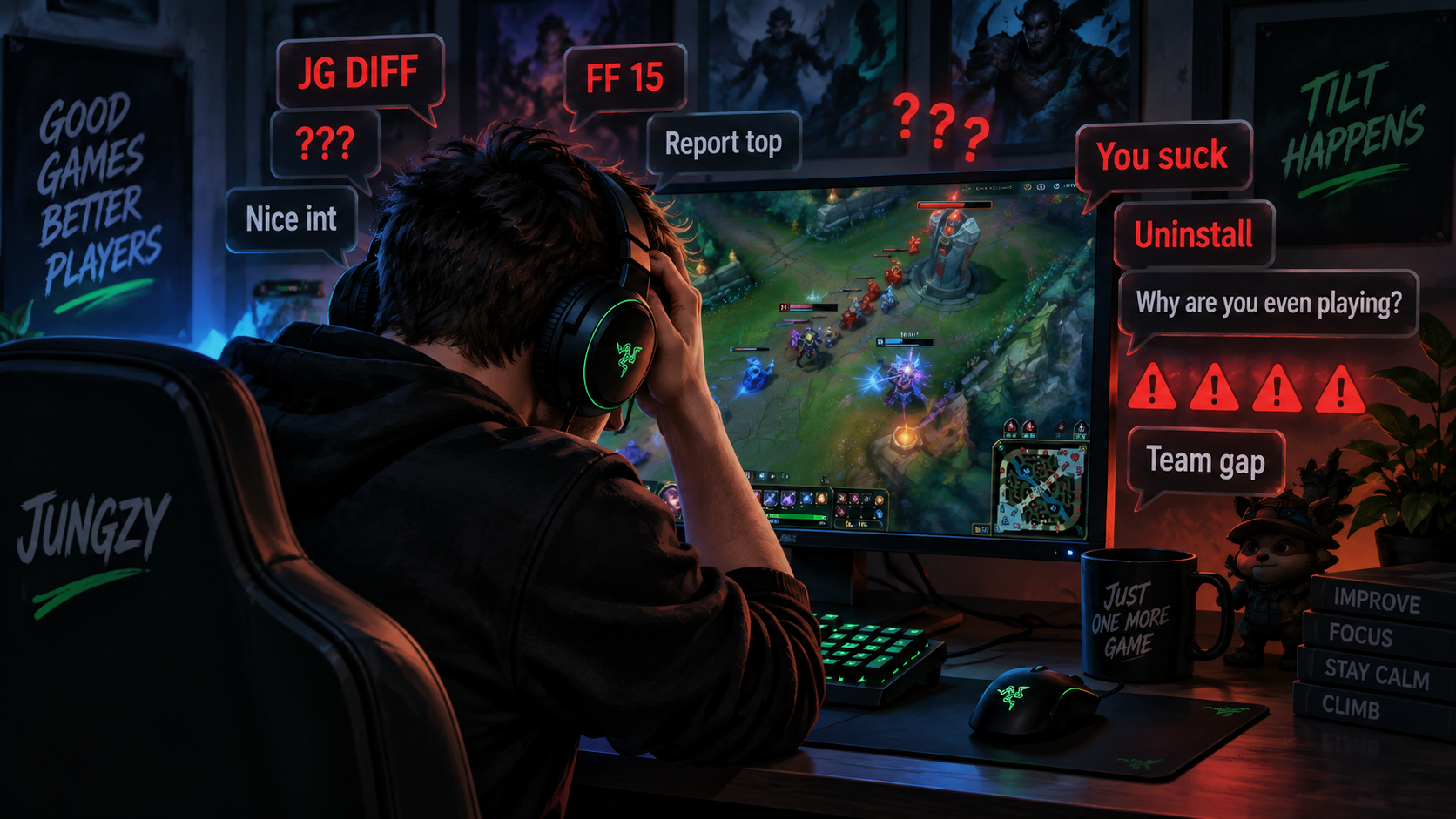
League of Legends has a reputation.
Tell someone you’ve been playing League for years and there’s a decent chance you’ll get some version of the same response:
“Isn’t that game incredibly toxic?”
It’s become almost inseparable from League itself. Feed your lane? Get flamed. Miss a Smite? Jungle diff. Make one questionable play? Someone starts typing an essay while standing in fountain.
I’ve spent a lot of time playing ranked Solo Queue, and I don’t think League is necessarily more toxic than many of the other competitive games out there.
Does League have toxicity?
Absolutely.
I’ve encountered the flaming, sarcastic pings, players giving up, people arguing for what feels like an entire match and the occasional player who gets mad after a few deaths and simply leaves.
But I think there’s more to League’s reputation than just saying it has a terrible community.
League puts five strangers into an unusually competitive environment and asks them to work together almost immediately. Add anonymity, LP, long matches, different personalities and five potentially different ideas about how the game should be played, and it’s not surprising that sometimes things go badly.
So how toxic is League really? And why does the game seem to bring this behavior out of people?
League Definitely Has a Toxicity Problem
We shouldn’t pretend otherwise.
Researchers have actually tried to measure problematic behavior in League rather than relying entirely on Solo Queue horror stories.
One study examined 328 competitive League matches and found some form of problematic behavior in 70% of the matches. Nearly 30% of the players observed engaged in at least one disruptive behavior.
That sounds awful.
But there’s an important detail.
The most common behavior wasn’t extreme harassment or threats. It was complaining about teammates’ performance.
Complaints appeared in more than half of the matches researchers examined.
That’s an important distinction because League players use the word toxic to describe an enormous range of behavior.
Someone intentionally feeding can be toxic.
Someone insulting teammates for 20 minutes can be toxic.
Spam pinging can be toxic.
Typing “?” after somebody makes a mistake might be considered toxic.
But those things aren’t equally serious.
And sometimes whether something feels toxic depends on the player receiving it.
Sometimes a Question-Mark Ping Is Just a Question-Mark Ping
I actually enjoy using chat and pings.
They’re part of League.
But players have very different personalities, and that’s something I think gets overlooked when we talk about toxicity.
One player might spam a couple question-mark pings because something funny happened. They may think they’re being sarcastic or lighthearted.
Another player could interpret those exact same pings as an insult.
And depending on what kind of day someone is having, something they’d normally laugh off might tilt them.
I’ve muted players myself.
Sometimes it’s not even because someone has done something unbelievably offensive. I simply realize that paying attention to them is distracting me from playing the game.
That’s one of the nice things about League: you can mute someone’s chat or pings and get back to playing.
For me, there’s also a difference between someone getting frustrated and someone being genuinely toxic.
The players who stand out are often the ones who don’t know when to stop.
Someone gets angry about a play and spends the next 20 minutes insulting another player. At some point, they’re barely playing League anymore.
They’re playing the chat box.
League Is a Test of Teamwork
One thing that’s easy to overlook when talking about League’s toxicity is what the game is actually asking players to do.
Every time I queue for ranked Solo Queue, I’m essentially being asked to form a functioning team with four strangers within a matter of minutes.
We don’t know each other’s personalities.
We don’t necessarily agree on how the game should be played.
Yet we’re expected to develop some kind of team synergy almost immediately.
That creates friction.
Maybe one player thinks we should contest an objective while another thinks we should give it.
Someone wants to split push while the rest of the team wants to group.
One player thinks they’re the shot caller. Another player thinks the call is terrible.
Neither person necessarily has to be trolling. They may simply have completely different ideas about how to win the game.
Now add ranked competition.
People aren’t necessarily playing just to pass the time. They’re trying to win and climb.
Their time matters to them.
A League match can consume 30 or 45 minutes, and spending that time on a loss—especially one you believe was caused by someone else’s decisions—can be incredibly frustrating.
League essentially creates a pressure cooker: five strangers, different personalities, different strategies, significant time invested and a ranked system where everyone cares about the result.
Sometimes those players are going to clash.
Anonymity Changes How People Behave
I also think anonymity plays a role.
People will say things to someone behind a League username that they probably wouldn’t say to someone they were playing basketball with at the local court.
There’s a social consequence to screaming at the guy standing five feet away from you.
There’s much less of one when you’re sitting at your computer and may never interact with the other player again.
I’ve noticed an interesting version of this with smurfs and alternate accounts.
When players are competing around their normal Elo on their main account, they may repeatedly encounter some of the same people. There’s at least a possibility they’ll see those players again.
On an alternate account at a different Elo, that sense of accountability can disappear.
Some players simply don’t seem to care as much.
Riot has recognized a version of this problem too. The company has worked on linking alternate accounts for penalties so players can’t necessarily treat secondary accounts as disposable places to misbehave without consequences reaching their main account.
That’s a meaningful change.
Accountability matters.
You Have to Learn How to Lose
I think one of the best things a League player can do for their own enjoyment is accept a simple reality:
You’re going to lose. A lot.
It sounds obvious.
I’m not sure everyone really accepts it when they click the ranked button.
League’s matchmaking is supposed to produce competitive games. As you reach opponents around your skill level, you can’t reasonably expect to keep winning 80, 90 or 100 percent of your games.
Losses are inevitable.
But if you enter every match believing that you should win, every loss suddenly needs someone to blame.
The jungler didn’t gank.
Bot fed.
Someone picked the wrong champion.
Top wouldn’t group.
Someone missed Smite.
Sometimes those things genuinely contribute to a loss.
But you’re still going to lose games.
Learning how to deal with that is part of playing League.
Even when my team is being dominated, I can still try to work on something.
Maybe I can improve my farming while playing from behind. Maybe I can practice my positioning. I can work on vision, decision-making, objective timing or simply practice not allowing one bad decision to turn into three more.
That doesn’t mean you have to enjoy getting stomped.
It means a losing match doesn’t necessarily have to be wasted time.
If you can get something useful out of the loss, there’s also less reason to spend 30 minutes looking for someone to blame.
You can’t completely control what your four teammates are going to do.
You can control how you respond to it.
And Sometimes Players Give Up Way Too Early
This is one of the behaviors I find particularly frustrating.
I’ve been in games where someone dies two or three times, gets angry and essentially decides the match is over.
Sometimes they’ll repeatedly try to surrender.
Sometimes they’ll mentally check out.
And occasionally they’ll just leave.
At the same time, I’ve been in plenty of losing games where surrender votes repeatedly fail because other players still want to play.
That’s important.
For every player screaming “FF” because the game started badly, there may be several teammates who still believe they can win.
And League has continued adding comeback opportunities and systems that can make games harder to completely close out.
Nexus turrets, for example, can now respawn after being destroyed.
A terrible start doesn’t automatically mean a match is over.
Getting your feelings hurt after your third death definitely doesn’t mean it’s over.
Riot Hasn’t Ignored the Problem
Another reason I don’t think League completely deserves its old reputation is that Riot has spent years trying to address player behavior.
And from my experience, some of those systems seem to be having an effect.
After games, I frequently receive Instant Feedback Reports indicating that action was taken against someone for inappropriate behavior.
That’s meaningful.
It tells players that reporting someone isn’t necessarily equivalent to throwing a complaint into a black hole.
Riot has also increased the potential consequences for seriously abusive communication. In 2026, the company expanded punishment for sufficiently severe abusive chat so that it can result in gameplay bans rather than merely communication restrictions.
There is also the Honor system.
Instead of only punishing bad behavior, Riot has tried to reward players for being good teammates. Higher Honor levels can provide rewards and other benefits, giving players at least some positive incentive to behave well.
None of these systems magically eliminates toxicity.
But they’re meaningful attempts to change the incentives around player behavior.
Streamer Mode Addresses Another Kind of Toxicity
Riot has also introduced stronger privacy protections through Streamer Mode.
One of the problems League players could encounter was having other players look up their accounts during a match.
Someone sees your stats on a site like OP.GG, decides they don’t like what they see and suddenly your match has become a discussion about your win rate instead of the game you’re currently playing.
Streamer Mode can conceal identifying information and make it more difficult for players and third-party applications to identify an account during the match.
I think that’s a positive change.
The fewer opportunities players have to find reasons to attack one another before the game has even finished, the better.
A Little Karma Goes a Long Way in League
There’s also something to be said for approaching League with the idea of karma.
I don’t mean that Riot secretly puts nice players on better teams.
I mean that the way you behave can influence the environment you’re playing in.
If you’re a good teammate, communicate constructively and don’t immediately turn on someone after a mistake, there’s a decent chance you’ll get some of that behavior back.
Your jungler misses Smite.
Your top laner loses lane.
Your ADC gets caught before an objective.
You can question-mark ping them six times and explain exactly what you think they did wrong.
Or you can move on and try to win the next play.
I’ve found that League becomes much more difficult when players start fighting among themselves.
One insult leads to another. Someone starts typing instead of playing. Another teammate joins the argument.
Pretty soon you’re spending more energy fighting your own team than the enemy.
The opposite can happen too.
Being encouraging, acknowledging a good play or simply refusing to participate in an argument can help keep a team together.
It won’t magically turn every losing game into a win.
But if you queue into every match expecting four strangers to tolerate your mistakes while you refuse to tolerate theirs, you’re probably going to have a miserable time.
Be the teammate you’d want to get in Solo Queue.
You might be surprised how often other players return the favor.
Is League More Toxic Than Other Games?
This is where I’m much less convinced by League’s reputation.
Toxicity isn’t unique to League.
Competitive online games have been dealing with harassment, griefing, AFKs, smurfing and angry teammates for years.
Research comparing discussions around League of Legends and other competitive games has found many of the same complaints across gaming communities.
And personally, I don’t find League egregiously more toxic than other mainstream competitive games.
What League does have is a particularly effective combination of ingredients for creating frustration.
Matches can be long.
You’re heavily dependent on teammates.
Individual mistakes can affect the rest of the game.
Your rank is involved.
You can’t simply leave when you’re having a bad time without consequences.
And four strangers are constantly making decisions that affect your chances of winning.
That environment can bring out some pretty unpleasant behavior.
But that’s different from saying League players are uniquely terrible people.
Should Toxicity Stop You From Playing League?
No.
If someone told me they were interested in League but had heard the community was so toxic that they were afraid to try it, I’d encourage them to play.
You have options.
Mute someone’s chat if they’re bothering you.
Mute their pings if necessary.
Block players you don’t want to interact with.
Play with a duo or friends.
Put on some music and focus on your own game.
You can also experiment with different game modes that don’t necessarily have the same competitive atmosphere as ranked Solo Queue.
And give yourself time.
As you play more League, you’ll start figuring out where you fit into a team.
Maybe you enjoy being the person making calls.
Maybe you’re happier supporting someone else’s plays.
Maybe you’ll discover a particular role or champion that fits your personality.
Learning those things is part of learning League.
Don’t let the possibility of encountering a jerk prevent you from experiencing everything else the game has to offer.
So, Is League of Legends Really That Toxic?
Yes and no.
League unquestionably has toxic players.
I’ve encountered people who flame, spam pings, give up, leave games and spend enormous portions of a match insulting their own teammates.
Research also supports the idea that disruptive behavior is a genuine problem.
But I don’t think League is uniquely toxic compared with other major competitive games.
I think League is unusually good at creating the conditions that can produce toxicity.
Five strangers.
Anonymity.
Different personalities.
Different ideas about how to win.
Thirty or forty-five minutes invested.
LP on the line.
And the unavoidable reality that you’re going to lose plenty of games.
Put all of that together and sometimes people aren’t going to handle it particularly well.
Riot can’t eliminate that completely.
But I do think the company has made meaningful improvements. Better punishment systems, Instant Feedback Reports, Honor incentives, privacy features and stronger consequences for severe behavior all help.
Players have some responsibility too.
Mute someone when you need to.
Don’t expect to win every game.
Don’t turn one teammate’s mistake into a 20-minute argument.
Try to learn something from losses.
And remember that the other four people on your team are trying to navigate the same chaotic game you are.
League can be frustrating.
League can absolutely be toxic.
But after spending plenty of time in ranked Solo Queue, I don’t think its reputation should scare someone away from playing it.
Besides, if someone question-mark pings you six times after you miss a play, there’s always the mute button.